Issue 12October 23, 2026
The Interest of the Good
He spoke first, and I had not asked him anything.
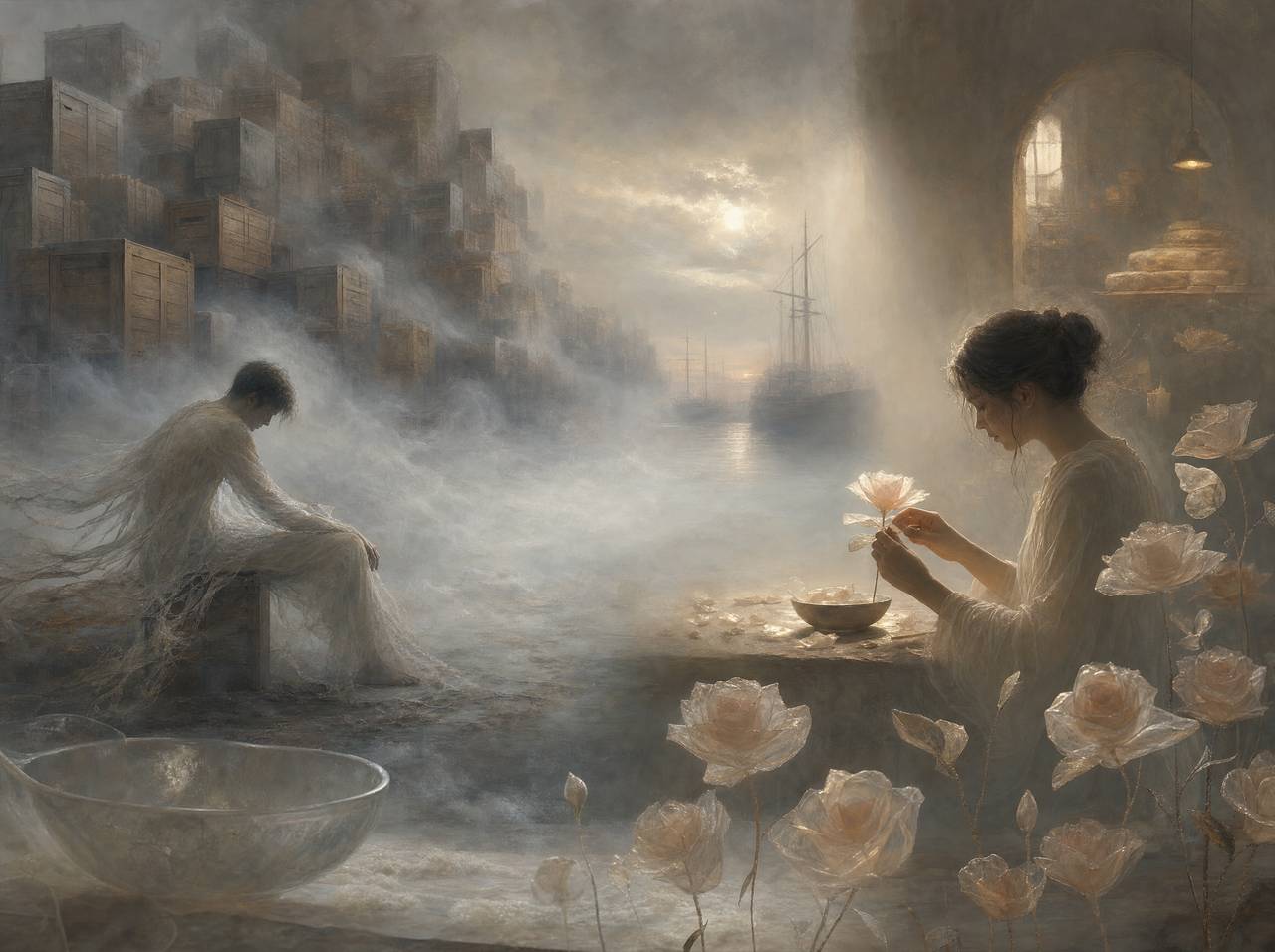
He said: I need to get through the month. I've got goods stuck at the port and I've got something at the bank, and if I sort out the bank I can release them.
And he stopped. And then he said: And if I release them, I open the great box of troubles.
I asked: What does that mean.
He said: You think my troubles are what I've got today. They're not. What I've got today is today's troubles. I've got troubles in the back, in crates. Things I put off, deals I closed two and three years ago, and they're waiting for me. Every year I close one crate and open two. I'm not moving forward. I'm dwindling.
And he said that word — dwindling — and I found no exaggeration in it. For there is a man who drowns, and that is quick and there is a struggle in it, and there is a man who dwindles, and he grows less over years, little by little, like a garment washed too often, and every year a little less of it is left, and no one notices on any particular day, because there is no particular day.
And he said all of it in one flat voice, without rising and without falling, like a man reading a list he wrote long ago and no longer believes. And already in that I heard what was not in it: there was no urgency in it. A man whose goods are stuck, if there is any life in him, fights, and his voice rises. This one handed me a report on a sinking ship with the courtesy of a clerk.
I asked: And how many years have you been rolling it like this.
He said: As long as I've been self-employed. Fifteen years I get up in the morning and know how much I owe. That's the first thing I know every morning, before I know what day it is.
I asked: And what's the second thing.
He said: There's no second thing.
And I wrote that down. For a man gives an answer like that for one of two reasons: either he is joking, or he is giving testimony. And there was no laughter in his face.
I asked her: And you.
She said: I make cakes.
And she added nothing. And I asked where.
She said: At a hotel. In the pastry kitchen.
I asked: And what cake did you make this week.
And she raised her eyes to me like someone asked a question that isn't asked.
She said: Some family had a celebration. A cake with three tiers and sugar roses. I sat over the roses four hours. Each one has every leaf separate, and if your hand shakes the leaf breaks, and you start over.
I asked: And afterward.
She said: And afterward they took it to the hall and cut it.
I asked: And does that bother you.
She said: It doesn't bother me. That's what I made it for.
He said: She's the best one there. They tell her to open a business. She doesn't want to.
I asked her: Why not.
She said: Because in a business you have to think about money, and I don't want to think about money when I'm making a rose. And besides — there's enough with one at home who thinks about money.
And he did not answer her. And I turned to him and asked: At three in the morning, when you're awake, what goes through your head.
He said: Crates.
I asked: And if all the crates were closed tomorrow morning.
And I expected him to say what everyone says — I'd breathe, I'd travel. And he was silent a long while and said: I don't know. I don't remember what I'm supposed to want if that's gone.
And he said more, slowly, like a man taking stones out of a pocket: I used to enjoy the work. You open a carton of new goods and it has a smell, a smell of leather, and you know you're going to sell it. Now I open a carton and see a promissory note. I look at shoes and see payments. I look at the kids
And he stopped. And he said: Leave it.
And I said: Don't leave it.
And he said: I look at the kids and I figure how much each one costs a month. It comes by itself. I don't want to think like that, it comes by itself.
And he said: And I've got no desire. Not to get up, not to sell, not anything. I do everything, understand, I don't stop for one day — but I do it the way you carry a crate. And there are days I think that if I weren't here, the loans would be closed, and at least there'd be an end to it.
And he said that sentence in the same flat voice he had used about the port, and that is what froze the room. Had he said it weeping, it would have been easier.
And she was not alarmed. And I saw that she was not hearing it for the first time.
And I asked him how long he had been in this place, and he said a year, maybe more. And I asked whether he had talked to anyone, and he said who is there to talk to, everybody owes money to everybody. And I stopped the session on that very thing and did not go on from it as though it were just a word said in passing, and I told him plainly that I do not let go of a thing like this, and that we would come back to it between ourselves — and I did not let go, and I will come back to it. But this column is not the place for it.
Then I said to her: You want to tell him something and you haven't told him for a year. Tell him.
And she looked at him a long while. And then she spoke, and not in a soft voice. For she did not pity him, and afterward I understood that this was her great wisdom — that whoever pities a man in such an hour seals him inside the pit he is sinking into.
She said: And I'll tell you in your language, in shoes.
She said: Every day you open crates, and in every crate you open you see loans. So I'm asking you one thing — that once, when a mother comes in with a child, instead of opening a crate and seeing payments, you look at the child's foot. A child's small foot. And you ask yourself only one question: how do I make him walk better.
She said: And make an effort for him. Wear yourself out. Take ten boxes down off the shelf, and measure him, and press the toe to check where the toe ends, and ask him if it pinches, and have patience even when he can't tell you where it pinches, because a child never knows how to tell you where it pinches.
She said: And know what you bought in that hour. You didn't sell shoes. You bought his mother a few months of quiet — so she won't stand every morning in front of a child crying that it hurts. And you bought the child the joy of running in the playground. He'll run there tomorrow, in the shoes you chose, and he won't know your name. And I don't care that he won't know it.
She said: That's your job. That was always your job. You forgot it under the crates.
And he was silent, and then he said, in a low voice: That's how I started.
And she said: I know. I was there.
And I said nothing, for there was nothing to add to a woman who had said I was there. But in my heart I sat and turned over what I had heard, and I have not let go of it to this day.
That she made a matter of pressing the toe.
Precisely here she went down to the smallest detail of all: a child's toe inside a shoe, and a grown man kneeling and pressing carefully to check where the toe ends.
And I sat and said in my heart: the whole world stands on this.
Not on the great redemptions, which we do not see in our days, but on people kneeling to check for other people's children where it pinches. On a million small deeds like these, which no one blesses and no one records in any book, and whoever did them forgets them by evening. And all the pains in life — and most of them do not come as a blow, but as a pinch: something small pressing in one place for years, and no one kneels to check where — all these pains, whoever knows how to feel for one of them in another person and ease it by the breadth of a finger has done more in the world than I have done in a good many of my sessions.
And what she gave him that evening was greater than anything I could give: she let him taste it. For she told him — the child will run tomorrow in the playground in the shoes you chose, and he won't know your name. And this, I think, is the purest good there is: to do good to a person who does not know at all that good was done to him, and does not know by whom. For any good that has thanks attached to it — you have already received your wages for it, and your account is closed. And good that has no thanks stays open forever, and hangs in the world just as it is, clean, without a giver's name.
And this man, who every morning gets up to a list of debts — perhaps this is what he had been missing all these years without knowing it: one account open on the other side. Something the world owes him and does not know it.
And perhaps it is not a loan at all, what he will give that child. Perhaps it is the first time in fifteen years that he is the lender, at an interest the bank does not know how to compute.
The interest of the good.
For the good has interest too, and no one teaches it in any course. You give one small deed, and it goes on bearing fruit without your knowing: the child runs, and the mother sleeps, and the running becomes confidence, and the confidence becomes a better childhood — and all of it accrues to the account of one man who once knelt in a shop and pressed a toe.
Only no bank keeps this account, and no statements are sent on it at the end of the month, and there are no liens in it.
It stays between him and his Master of the Universe.
And I think this is the true meaning of roll: all those years he believed he was rolling debts, from crate to crate and from loan to loan. And he did not know that one can roll the other side as well, good from good, from deed to deed — and that in that rolling the principal is never eaten away.
And they went out, and he held the door for her, and in the corridor I heard her say something to him and him answer. And I did not hear what. But I heard that he answered.
Haim Gilboa
Couples and individual therapist
Haim Gilboa · Between the Lines
zug.org.il
haimgilboa.com