Issue 8September 25, 2026
This Gap Is What Made the Magic
They came in, and he sat on the edge of the chair, not deep in it, like a man sitting in a place he may have to get up from at any moment. And she sat deep. And that is the whole difference between them, and the rest is commentary.
I asked what brings you here.
She said: He comes home once a week, and he explodes.
He said: I don't explode. I raise my voice when a voice needs to be raised.
I asked her: When was the last time.
She said: Friday. Because of shoes in the entryway.
I asked him: Is that true.
He said: That's true.
I asked: And how many hours before that had you been in the field.
He said: I went out at four in the morning.
I asked: And when before that did you sleep a whole night.
And he thought, and that itself was the answer, and he said: The last leave. Maybe.
And already in those three answers the whole file lay before me, and I did not yet know how to read it.
I asked him about the base, and he told me, and not with enthusiasm but like a man delivering a report. Field conditions, and nights, and a telephone that rings at two, and responsibility for lives. And I asked what happens when a senior commander lays into him.
He said: I absorb it.
I asked: Do you answer anything.
He said: You don't answer. You say yes sir and you write it down. Do you know where I work? I'm a combat officer in the career track.
I asked: And in front of your soldiers.
He said: In front of them you can't be edgy. Hard, yes. Edgy, no. A soldier smells it right away. You stand in front of them quiet.
I asked: How many hours a day are you quiet.
He said: All day. All week.
I asked: And where does it come down.
And he did not answer. And she answered: At our house.
And I said: On Friday.
And she said: In the first three hours of Friday.
And there was no triumph in her voice, and that is what held me in my chair. There are women who say a sentence like that in order to win with it; and this one said it like someone reading from a ten-year weather report. Ten years, and five children.
And I asked him about his men, and here I saw something I had not seen in him before. From the moment he began to speak of them his voice changed. He told me about one boy whose mother had fallen ill and who had no money to travel, and what he did for him, and how he moved heaven and earth for one form.
And I asked: And when you do a thing like that, what are you giving up.
He said: What do you mean, give up. That's what needs to be done.
And I wrote that sentence down for myself, for it is the whole man.
For there are great strengths in him, and I am not flattering him: this is a man who has the strength to carry what many do not carry, and to stand where others give way. Only that there are no rooms in him. A man is generally built like a house with inner walls, and when he gives he gives one room and closes it behind him and the house remains his. And in him there is one great hall, and there is no door in it. And when he gives himself over, it is not the devotion of a man to a task but of a man who has vanished into it, and erases the line between himself and it, until he does not know where the man ends and the duty begins.
And a man who gives this way gives on one condition that he never admits to and perhaps does not know of: that a day will come and someone will give himself over to him this way. And that is what he is driving toward every Friday, and he does not know that he is driving toward it.
And I asked her what she is asking for. Not what should stop — what she is asking for.
And she said: A little tenderness. Once a week. Five minutes. That he should come and put a hand and say something in a different voice. I'm not asking him for the world. I know what he does there. I'm asking for a drop. Because if he gives me a drop on Friday, that's enough for me for the whole week.
And I stopped writing.
For she is not asking for a hall. She is asking for gunpowder. A grain. And this woman knows of herself what she is, and I do not know from where — knows that she burns by her own strength for six days provided there is someone to light her once. And ignition does not require quantity, only a spark and dry matter.
And it turns out that this whole file, over its ten years, is nothing but an error in the accounts of two honest people: he comes to receive complete devotion, which is the only gate he knows, all or nothing. And she is asking him for a drop, and does not receive that either. And he supposes that she is demanding more than he has. And she, with the last of her strength, has nothing left in the magazine, for five children and six days alone — and a woman like that arrives at Friday with herself waiting for a spark, not giving one. And in the evening two empty people sit, and each waits for the other to begin.
And in the middle of all this I wanted to know a small thing, and I asked her what she tells him in the midweek calls.
She said: Everything's fine.
I said: And is that true.
She said: Not always.
I said: And why.
She said: Because what is he going to do from there.
And he turned to her and said, and no longer in the voice of a report: You don't tell me things.
And she said: I tell you the things there's something to be done about.
And here I sat in silence, for I saw that something had opened here that I had not known was in the room.
For this woman has a secret in her. And not a secret of deeds, heaven forbid, and I suspect her of nothing — a secret of life. That for all those six days she lives a whole life of which he knows nothing. There is a morning there, and there is a quarrel between two of the children and a making-up between two others, and there is a thing a neighbor said to her on the stairs, and there is one hour in the afternoon in which she sat alone and was silent and no one in the world saw her. And all these gather in her and are not handed over, some because there is nothing to be done with them, and some because there is no time, and some — and this she did not say — because they are hers.
And whoever has a life that is not handed over has mystery in him. And mystery is not a deed that one performs; it is what remains when one has not told.
And therefore, when he comes in on Friday, he is not coming in to a woman he knows. He is coming in to a house in which things happened in his absence. And that is what brings him to life, and I do not know whether he has ever known it: for his whole week is made of things known in advance, and orders, and timetables, and there is no mystery in it at all, and there is nothing in it that he does not report. And here there is one place in the world where he does not know everything, and one woman who is not handed over to him whole, and by this alone she returns him to life.
And from here on I am writing what I saw with my own eyes and I am not sure I will know how to explain it to them.
That she noticed he was listening.
And in that moment something in her changed. Not in her face — in her back. A woman who had sat slightly bent the whole meeting, in the way of one who carries, sat suddenly upright. And not because she had said something clever, and not because she had won the argument, but because she had seen, for the first time in years, that there is something in her that he wants to know and does not know.
And this is the thing: she had never thought she had any magic.
This woman supposes of herself that she is a function. That she is the house, and the calendar, and the laundry, and the accounts, and the thing that holds it all up so it will not fall. And every woman like that, after ten years, no longer remembers that she is also a person one might want to know. And in that second in which she saw that he wanted to know — she became enchanted in her own eyes. And since she became enchanted in her own eyes, she became enchanted in his as well. And since she became enchanted in his eyes, he went on looking. And so the thing goes in a circle that has no beginning, and I do not know who lit it here, and it seems to me that the matter itself is what lit it.
And this is all the gunpowder she was asking for, and did not know how to say it in words: not the tenderness of a caress. Curiosity. That there should be one person in the world who wants to know what she went through on Tuesday.
And toward the end of the meeting the thing happened.
And he was tired by then, I saw it in him, and his hands on his knees like stones. And he moved his hand — did not lift it, moved it — and slid it across the table in her direction, slowly, like a man whose strength ran out a third of the way and who leads his hand instead of carrying it.
And it did not reach her hand. It stopped about a handbreadth before it.
And he said: My heart is empty. And not because I don't want to give it to you. I have nothing left. I'm left only with gunpowder, a little for myself. And the last devotion I have — I'm willing to give it to you.
And he did not weep, and I do not know whether he understood what he had said.
And I was glad, and I am not in the habit of writing that word. I was glad like a man who has waited a whole hour for someone to say something in his own language, and at last he said it.
And I said to him: That is your terminology. Gunpowder. You said it, not I. And that is exactly what she is asking of you, and in those very words, and the two of you have been speaking the same language for ten years and did not know it.
And I said: Give her that little bit. Not the hall and not the whole and not the great devotion you give over there. The grain. And afterwards do the hardest thing in the world for you: wait. Do not fill yourself with anything — not with work and not with the telephone and not with getting up to put something in order in the house. Sit empty and wait. And see how it comes back to you from her.
And he asked: How long.
And I said: I do not know. A second. A minute. A day. A week.
And he did not answer.
And as for the hands, I said nothing to them, and I do not know whether they noticed at all.
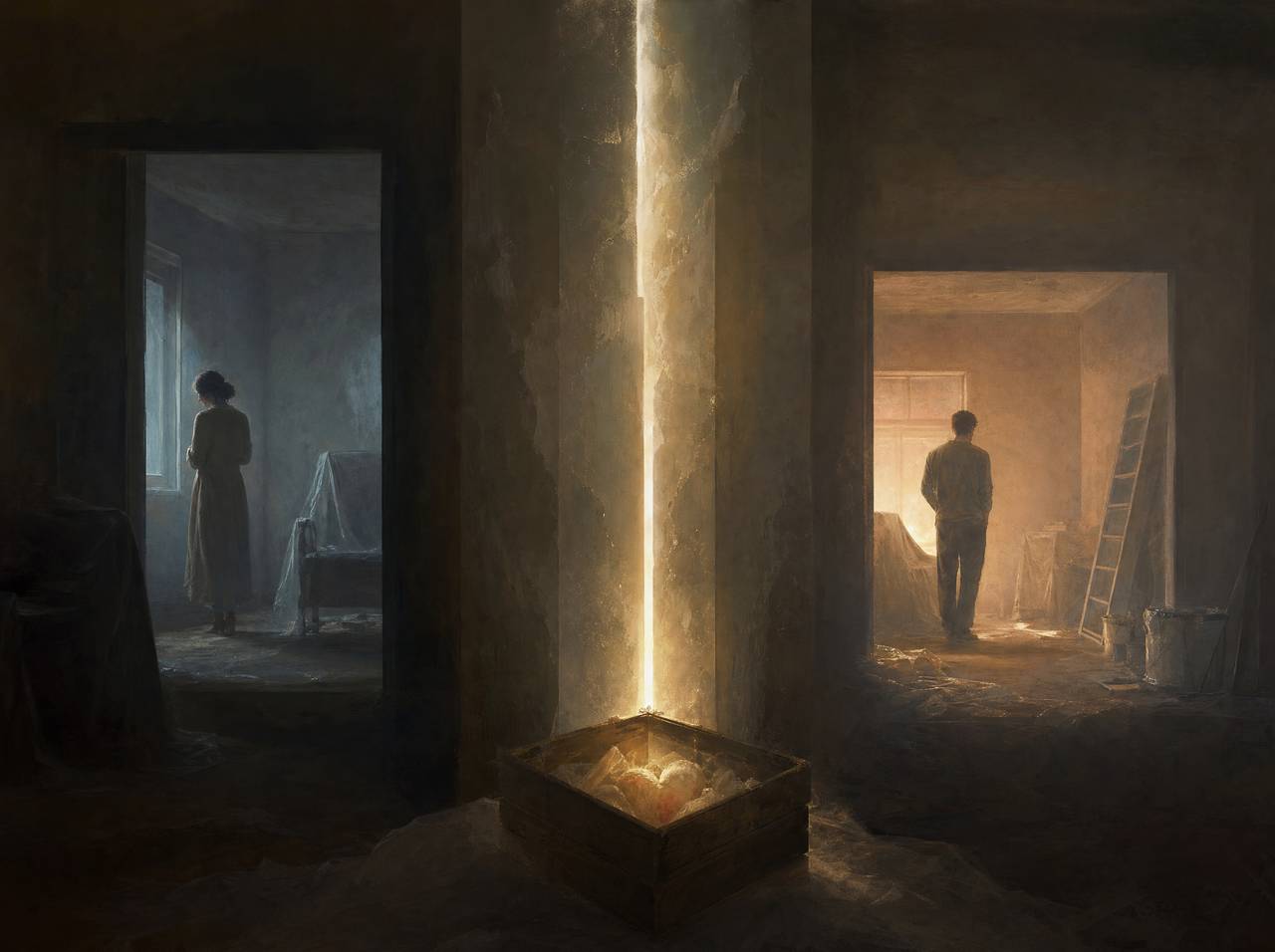
For his hand stopped a handbreadth before hers, and she did not put out her hand toward it, and did not draw it back to herself. And two hands remained on one table, close, and not touching. And had he touched her, it would have been finished: it would have become a deed, and a deed has an end, and after it people get up and go. And since he did not touch, that small gap remained there, and all the air in the room stood inside it.
And this gap is what made the magic.
For this distance is the only one that has a promise in it, since there is nothing in it yet and everything is possible in it. And a woman who all her days receives the touch of duty — a hand that helps to carry, a hand that pulls a child — received here a hand that does nothing. A hand that only came in her direction and remained standing. And there is nothing in the world that tells a woman how desired she is more than a hand that stops.
And one night, I sat here and put down the pen, and wrote a thing of no use to anyone.
For now, at this hour, he is running in mud. I do not know if it is mud and I understand nothing of army matters, but it seems to me it is so: night, and the light of one lamp, and the sound of breathing, and one boy who has fallen behind and he goes back to get him. And there is in him at that hour no thought at all of his wife, and not because he does not love — because there is no room in him. A man carrying twenty boys on his back does not carry anything else along with them.
And at that very hour she is in the kitchen. And the hour is ten, and one of the five is not falling asleep, and one gets up to drink, and the dishes are in the sink, and tomorrow there is something at the school that she remembers there is and does not remember what. And she turns off the light and settles into the nearest chair and not on the couch, for from the couch it is hard to get up. And she says nothing to herself, for she has no words at an hour like this and she has no orderly sorrow — she has a small calculation: if I go to sleep now I'll have six hours, and if I fold the laundry I'll have five. And she gets up and folds.
And the two of them, at that hour, are occupied with sacred work, and have no time even to dream of love.
And we suppose that love ends because people have stopped loving, and that is a rare case. In most of the houses I have seen no one has stopped loving at all, only that the hour was never found. And love does not die — it is pushed aside, and every year a little more, until it becomes like that object they moved to the storeroom during a renovation, and no one threw it out, heaven forbid, and no one remembers either which box it is in.
And in what way does he love her? In that he absorbs an insult and does not answer, for if he answers he will lose the career track, and if he loses the career track the house does not stand. And no one knows that this is love, and he does not know it either.
And in what way does she love him? In that she does not tell him on Wednesday that the little one cried half the night, because she knows he can do nothing from there and that the knowledge will sit on him all week. And she says everything's fine. And that is a lie, and that is love, and I do not know how to separate them.
And at what hour do they love each other explicitly? It seems to me they have two hours in a day and they are no longer than two breaths. The one a moment before falling asleep, that second in which the body has already sunk and the head has not yet, and everything they put off all day rises at once, and before a man has managed to defend himself a simple longing rises in him without complication and without complaint. And the second a moment before getting up, that moment in which a man is already awake and has not yet entered the day, and before he remembers everything he remembers one thing. And in those two seconds, and not in the evenings they do not have and will not have, the love of two people like these exists.
And I do not know whether they know that this counts.
And there are couples whose love is measured by what they do for one another and who do not see one another while they are doing it. And this is a very great love and there is a very great danger in it, for it has no witnesses, and a man whose love has no witnesses begins after some years to think that he does not love. And this is the mistake that kills houses. They did not stop loving. They stopped seeing.
And therefore all my work with them, if there is work in it, is not to teach them to love, for they know how to love better than I. It is only to stand them once in one room, for five minutes, and to say to them lift your head, now you will see what all of this is for.
And afterwards let them go, he to his mud and she to her kitchen, and let them carry it another week.
And as for me, I am turning off the light now, and I carry no one on my back, and I have no kitchen and I have no mud, and I go to sleep at an hour of my own choosing.
And I do not know which of us is the richer.
Haim Gilboa
Couples and individual therapist
Haim Gilboa · Between the Lines
zug.org.il
haimgilboa.com