Issue 3August 20, 2026
This evening, after she left.
This translation was generated automatically and may be revised.
That small movement she made at the beginning still lingers with me: she sat down, and immediately moved her chair a handbreadth to the side, out of the lamplight. A woman who came to talk, and before she even opened her mouth, had already sought a place for herself where she could not be properly seen. I noted this handbreadth and said nothing about it.
And this is her matter:
Since her youth she has loved thrills, and all her days she has clung to dubious types, and does not know how to choose her love. So she said herself, without qualification, and without asking me to console her for it. And there is a rare honesty in this: one who knows how to say about herself, 'I don't know how to choose'—has already stood outside herself once and looked in from the side.
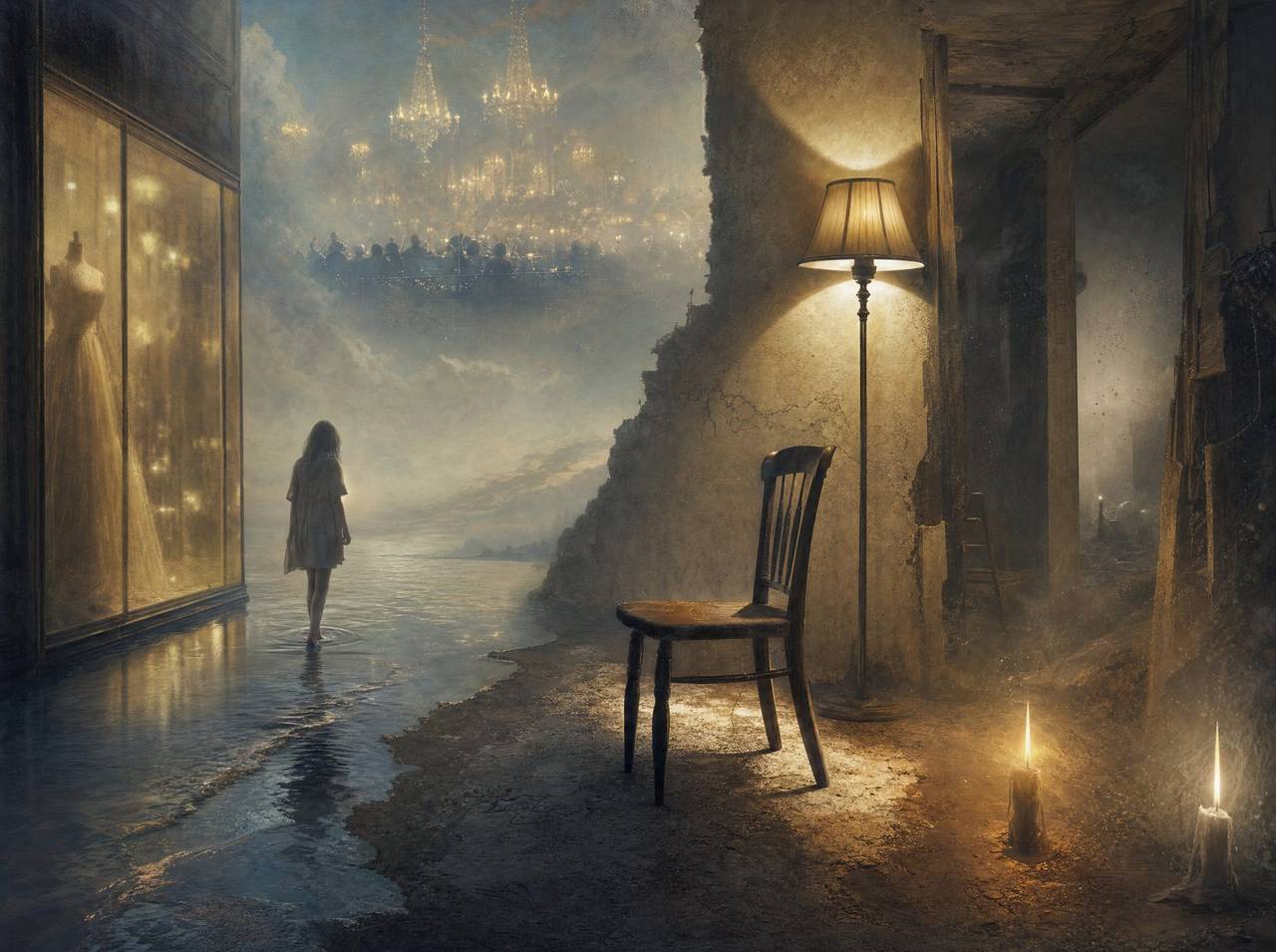
And what is that thrill she chases? I learned from her words that it is not joy at all, nor is it love. It is a kind of great hall, all filled with lights, where music is always playing, and no one knows who invited the orchestra or who is paying it. And anyone who enters there—his heart pounds in his chest, and his blood races, and his life suddenly becomes important to him. And without the thrill, the world becomes a small room with nothing but a table and a chair and a woman sitting on it at twilight.
And therefore she clings specifically to the dubious ones. For that hall opens only for one whose morrow is unknown. Certainty turns out the lights.
And now she is married. Two months into her marriage, and all the enthusiasm has faded.
And this I wish to make precise, for it is her entire case: nothing is missing. He is not bad to her, and he does not hit her, and he does not cheat, and she has nothing to complain about and no way to open the conversation. And this is harder than absence, because absence has a name, while this thing of hers—anyone who asks her, what are you missing, she has nothing to answer him, and since she has nothing to answer, she believes she is broken.
And he, for his part, asks of her only their desire. This he asks for every day, and in return he makes promises: a large and good family, a full home, many years. They are beautiful promises and I do not belittle them. But a promise, as long as it is not fulfilled, offers no sustenance—it is like a sign hanging on a shop that has not yet opened, which every passerby reads, but no one buys bread in. And so two people sit in one house, he asking in the present, and she existing in the sign.
And they have no children. And about this she said one sentence that contains nothing and contains everything: 'It's good that we don't.'
And this is her dilemma, as she laid it before me, the two paths arranged for her like two candles:
The first—to stay. And to finally carry out a renovation on her soul. To begin weaning herself from the hall of desire and fantasies, like a babe weaned from its mother, for all weaning is bitter at its start and the one who cries in it does not know that tomorrow he will eat bread.
And the second—to divorce, and to carry out that very same renovation with another. With someone who is interested not only in work and not only in domesticity, but truly, truly only in her. So she said, and she repeated the word, and when a person repeats a word—that is where he lives.
Except that this other has not yet shown his romantic capabilities.
And here I sat and said nothing, for it is not right to make a sound at such a time.
And the trap is laid on both sides, and I do not know how to decide it, nor do I pretend to. For she who stays—sometimes stays because she has understood, and sometimes stays because she has despaired, and the difference between them is not apparent until after seven years. And she who leaves—sometimes leaves because she has saved her life, and sometimes leaves because the hall has opened for her again elsewhere and they have called it by another name. Both directions exact a price; I only choose the currency, and even that I do not choose for her.
And the only thing I can say with certainty is this: the renovation is not done in any house she is not living in at the time of the renovation. No one renovates from afar. The water goes out, and dust rises, and there is no hot water for two weeks, and one sleeps between the exposed walls, and no one applauds the woman who stayed to sleep in a dismantled house. And this is the exact opposite of the hall of lights: there everything is given to her, and here she gives to herself, and there is no orchestra.
What did I do in the session: little. I asked her when, for the first time, she noticed there was a voice telling her what is beautiful and what is right, and it was not her own voice. She answered immediately, without calculating, the way a person does when the answer has been ready for years and he is just waiting to be asked.
And then she said the thing for which I am now sitting and writing and not going to sleep.
She said: If it were up to me, I would go on all the YouTube channels and all the platforms in the world, and speak to all of them at once, to all the nine-year-old girls.
And when she said nine-year-old girls, she did not say it as one states an age. She said it as one states a place. There is such a place in the world, and it lasts only a year or two, and those passing through it do not know they are passing through it: those years that are not childhood and not adulthood, and she stands on the riverbank and sees the flowing water and the coming year on the other side, and has not yet entered, and one of her feet is already in the water. And all that year she is looking.
And what are they looking for there, in that moment of standing? I wrote it as she said it, and I add nothing to it: they are looking for a mirror. And all the girls in the world at that age are standing and looking for a mirror, and not because they love themselves. Because they do not yet know what they are, and they have no way to see their faces except in the faces of others.
And from the world—Master of the Universe, how many mirrors it offers them. It shines its face on them from every side, screen after screen, voice after voice, and all of them say to her with great pleasantness: here, look here, here you will find yourself. And she does not know, that nine-year-old girl, that these are not mirrors at all but shop windows, and what looks to her like her own face is barely a reflection on glass behind which merchandise stands.
And this is what happens there, quietly, without a shout and without a tear and without her mother knowing: the girl learns, within that year, that she looks better in a certain window and less good in another window. And because of this, she begins to always stand before that same window. And because she stands there, her face becomes as the window likes it. And because it has become so, she no longer remembers what face she had before.
And no one ever forced her. This is all the sorrow of it. No one said a harsh word to her, and no one denied her anything—but they asked her, a thousand times a day, in a pleasant and soft voice: are you okay? does that look nice on you? do you like it? Until she became a great expert in the question of what pleases the eyes of those standing by, and was never asked one simple question: and you, what do you have there inside.
She told me: I would shout to them, start listening to yourselves. Only to yourselves. And not to the voices outside.
And she said this in a very low voice, like a person shouting in a dream, for the dream gives him the shout but does not give him the voice.
And I sit before her and make a calculation I do not share with her: one who knows with such precision what needed to be said to a nine-year-old girl, and at what hour, and in what voice—does not know this from stories. She has its name and address. And to this day she is standing on that street, a nine-year-old girl, before that same shop window, waiting for someone to pass by and finally tell her: I didn't come for the dress. I came for you.
And all those dubious types she clung to all her days, and the whole hall of lights and the orchestra whose inviter is unknown—all of these, by my calculation, are nothing but repeated attempts to have that same man pass by on that same street.
And I said nothing of this to her. One does not say such a thing to a woman as she stands at the door, holding her keys.
Haim Gilboa
Couples and individual therapist
Haim Gilboa · Between the Lines
zug.org.il
haimgilboa.com